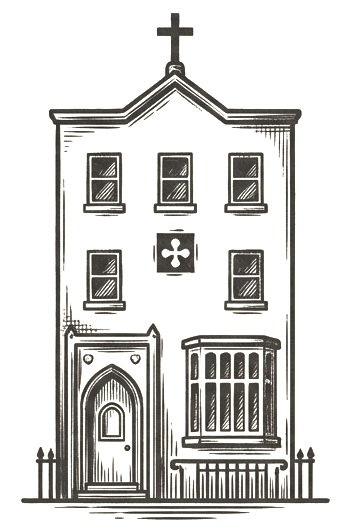
The buildings at 29 Nassau Avenue (the former school) and 29 Dobbin Street (the former convent) are part of a larger church campus that has anchored this corner of Greenpoint for more than a century. In the early 1900s, Slovak immigrants in North Brooklyn organized to establish their own parish, forming a spiritual and social center that would serve generations of neighborhood families.
Construction began in 1910, and in 1911 the church and rectory were completed and dedicated, establishing a lasting presence at Nassau Avenue and North 15th Street. In 1918, the parish opened a school. As the community grew, the campus expanded again: in 1930, a new school and an attached convent were completed, arranged around a shared courtyard. The school faced Nassau. The convent faced Dobbin. The whole thing cost $30,000, pooled from factory wages by people who understood that the point of arriving somewhere was to build something that would outlast you.
The front door tells you what the building was for. Three entrances, carved in stone: Boys. Girls. Convent. Three ways of being sorted before you crossed the threshold. The sisters who taught there belonged to an order founded in Scranton in 1903 for exactly this purpose: educating children of Slovak immigrants in their own language while preparing them for a country that spoke another. The convent upstairs was not a retreat. The sisters lived above the classrooms they cleaned, prepared, and filled each morning. The distance between rest and labor was one flight of stairs.
The school operated continuously from the early 1930s through 1978. Former students have left scattered accounts: three brothers who attended in the 1930s and 40s, a woman who remembers the late 40s and early 50s, a graduate of the class of 1965. Father John Oravez presided for decades. The diocese recorded the closure as a single line: Holy Family, 14th St. (1978). The neighborhood had changed. The building stayed.
After the school closed, the parish merged and the church became San Damiano Mission — passed first to Franciscan friars, then to Brazilian missionaries. The school sat largely empty for forty years. In 2019, a private day school called Ardor moved into the Nassau Avenue side, running language immersion programs for young children out of the old classrooms, gymnasium, and stage. They have since moved on.
Today, as the space is reimagined as an innovation and cultural lab, it carries forward a clear throughline: a place built by immigrants, shaped by educators and caretakers, and continually repurposed to meet the needs of its time. The next chapter builds on that legacy—honoring the site’s past while opening it to new ideas, disciplines, and communities.